

Every fleet manager knows the pre-trip inspection checklist. Walk the vehicle. Check the lights. Look at the tires. But how many drivers are actually catching loose wheel fasteners before they become a problem on the road? The numbers say: not enough.
Wheel separation — where a wheel detaches from a moving commercial vehicle — is one of the most dangerous failures in heavy trucking. It causes accidents, injuries, fatalities, and massive liability. It also happens far more often than most people realize, and the underlying cause is almost always detectable before it happens.
NTSB estimate — and likely an undercount, since many incidents go unreported when no crash occurs.
NTSB finding on the primary cause of commercial vehicle wheel violations.
CVSA International Roadcheck 2022 — the single largest out-of-service violation category.
How Often Do Wheels Actually Come Off?
There is no single federal dataset that tracks wheel-off events as a standalone category across all commercial motor vehicles. The data exists in pieces, and each piece tells part of the story.
The National Transportation Safety Board puts tractor-trailer wheel separations at roughly 750 to 1,050 per year. The NTSB notes this is likely a significant undercount, since many incidents go unreported when they don't result in a crash or a property damage claim.
Broader estimates covering all vehicle types put annual wheel-off occurrences above 30,000 nationally, contributing to over 900 accidents, more than 400 deaths, and over $45 million in property damage each year.
For fleet operators and maintenance managers focused on commercial vehicles specifically, the most actionable number comes from the CVSA's 2022 International Roadcheck — a 72-hour inspection blitz conducted across North America. During that event, wheel-end violations accounted for 22.8% of all out-of-service vehicle violations — the single largest category found. That figure has held near the top of the CVSA charts year after year. Roughly one in four commercial vehicles pulled out of service has a wheel-end problem significant enough to ground it.
"Wheel end violations historically account for about one quarter of all vehicle out-of-service violations found at each annual International Roadcheck."
These are not freak mechanical failures. They are detectable conditions — and largely preventable ones.
What Actually Causes Wheel Separation?
Wheel separation on commercial vehicles almost always traces back to one of three things: improper installation, insufficient maintenance intervals, or undetected loosening during operation.
The NTSB found that 40% of all wheel violations on commercial vehicles involve loose or missing nuts or studs. When lug nuts are not torqued to spec — whether under-torqued from a rushed roadside tire change or over-torqued to the point of stud stretch — the joint is compromised from the start. Normal road vibration, load cycling, and thermal expansion do the rest.
What makes this especially dangerous is that the loosening process rarely announces itself. A nut that has begun to back off does not trigger a warning light. The driver feels nothing unusual until the wheel is already at risk of separation. By the time it becomes audible or visible from the cab, the situation is often already critical.
The FMCSA Regulations That Apply
49 CFR 393.205 — Wheels
Wheels and rims must not be cracked or broken. Stud or bolt holes must not be elongated. Nuts and bolts must not be missing or loose. Violations carry CSA points that affect safety ratings and insurance rates.
49 CFR 392.7 — Pre-trip Inspection
Drivers must inspect the vehicle before operation. The inspection must include checking for loose or missing fasteners on the wheel assemblies. This regulation creates both a legal requirement and a liability record — the inspection either happened or it didn't.
The compliance picture matters beyond just avoiding a roadside OOS. A fleet that can demonstrate a systematic, documented loose-wheel inspection program is in a fundamentally different liability position than one that relies on driver judgment alone. Lug nut indicators make the 392.7 inspection faster, more thorough, and visually documentable. They also create a continuous equipment-condition signal that supports the 393.205 standard.
The Inspection Gap — and How to Close It
Pre-trip inspections are required under FMCSA 392.7. Drivers are expected to walk the vehicle and check wheel fasteners. In practice, a driver crouching to visually examine 18 or more lug nuts per axle — often in a dark yard before dawn — is not going to catch a nut that has rotated 15 degrees off its original position. The human eye is not calibrated for that kind of detection under those conditions.
This is the gap that lug nut indicators close.
How Lug Nut Indicators Work
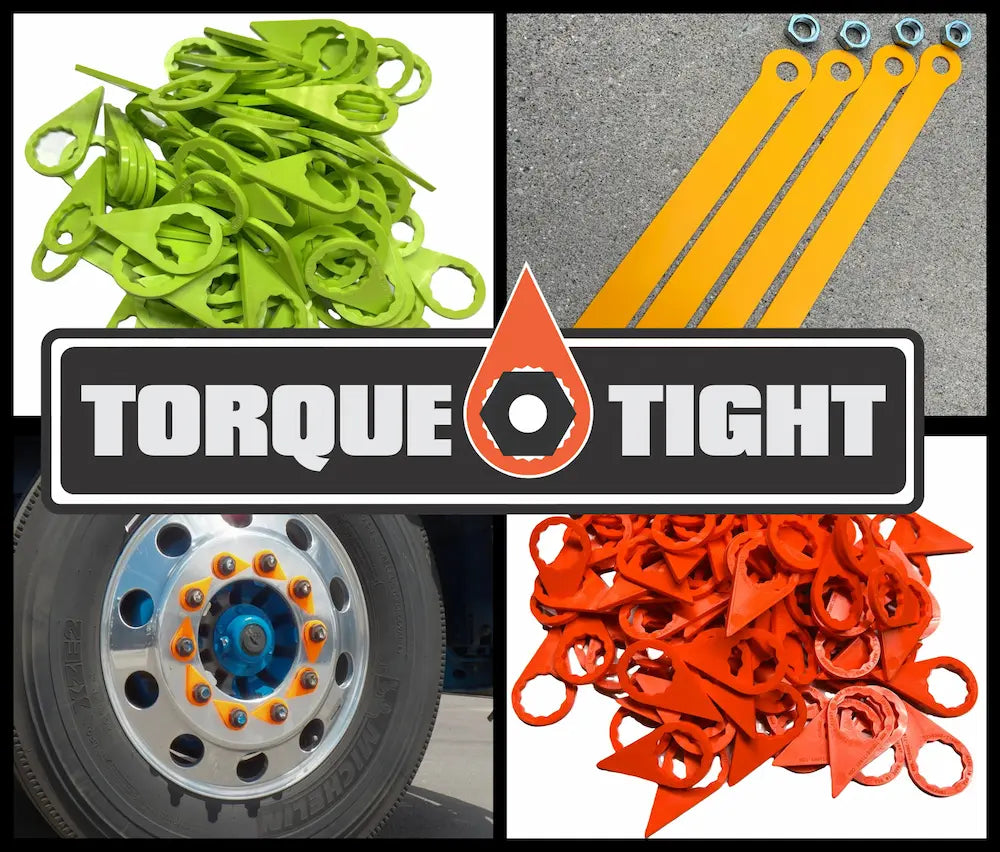
- A high-visibility indicator sleeve is pressed onto each lug nut at installation. No tools or adhesives required.
- All indicators on a given wheel are aligned to point in the same direction — typically toward the valve stem, or consistent across all wheels.
- When a lug nut begins to back off, its indicator rotates — visually, unmistakably — out of alignment with the others.
- During a pre-trip walkaround, a driver or inspector can cover an entire axle in seconds. A rotated indicator means: service this wheel before it moves.
No crouching. No measuring. No guesswork. A single glance at the wheel tells you whether every fastener is holding its position or whether something has moved.
What This Looks Like in Practice
Fleet operators who adopt lug nut indicators typically report two consistent outcomes: they start finding loose nuts they didn't know were there, and they stop worrying about the ones they can't see. The inspection process becomes faster, more consistent, and more defensible. Maintenance staff can document pre-trip checks visually. Supervisors can audit compliance across vehicles at a glance.
For transit agencies and school bus operators, the stakes are even higher. A wheel separation event involving a vehicle in public service is a public safety crisis with immediate media and legal consequences. The CVSA finding — that wheel-end violations are consistently the top out-of-service category — applies to transit buses and school buses as well as over-the-road trucks.
Many transit agencies have adopted lug nut indicators as a standard part of their maintenance programs precisely because the indicators support both FMCSA pre-trip documentation requirements and internal safety KPIs. The visual check is fast enough that it actually happens on every vehicle, every day — which is the only version of an inspection that reliably prevents failures.
Torque-Tight: Made in the USA for Commercial Applications
Torque-Tight lug nut indicators are manufactured in the United States — injection molded at Sovereign Plastics in Colorado Springs, Colorado — and are Buy America compliant. They are independently UV-tested to ASTM G154-23 standards (500 hours, ISO 17025 certified lab), engineered for the temperature extremes and road abuse of commercial vehicle operation, and available in every common metric and inch lug nut size used on Class 6, 7, and 8 trucks, trailers, transit buses, and school buses.
Sizes include 33mm (the standard for nearly every Class 8 tractor and commercial trailer in North America), 32mm, 38mm, 27mm, 22mm, 21mm, 13/16", and more. Bulk pricing is available for fleets, transit agencies, and distributors. Custom colors available for large orders to support fleet-wide color coding programs.
Wheel separation is a preventable event. The CVSA data tells us it is happening at scale — year after year, as the leading out-of-service category for commercial vehicles in North America. The technology to detect the underlying condition before it becomes a wheel-off event is simple, low-cost, and available today. The question is whether your fleet is using it.
Ready to close the inspection gap?
Shop by lug nut size or request samples for fleet evaluation. Bulk pricing available. Ships from Michigan.